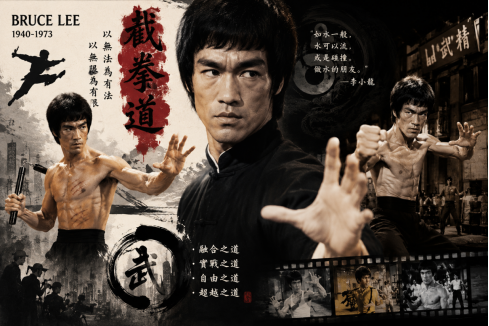
From Technique to Philosophy: Bruce Lee and the Globalization of Chinese Martial Arts
Bruce Lee (1940-1973) was one of the most influential martial artists and a cultural communicator worldwide in the 20th century, and an important symbolic figure in the modern transformation of Chinese martial arts. He was more than a star of action films; through his distinctive martial arts philosophy and systematic framework, he propelled Chinese martial arts from traditional techniques onto the global cultural stage.
Born in San Francisco, USA, and raised in Hong Kong, Bruce Lee came under the artistic influence of his father Lee Hoi-chuen from an early age, and later studied Wing Chun under Ip Man. Through long years of martial arts training, he gradually recognized the limitations of traditional schools, and began to ponder the essence of martial arts: he believed that its core lay not in fixed routines, but in “how to solve problems effectively in real combat.” This reflection became the intellectual starting point from which he later founded Jeet Kune Do.
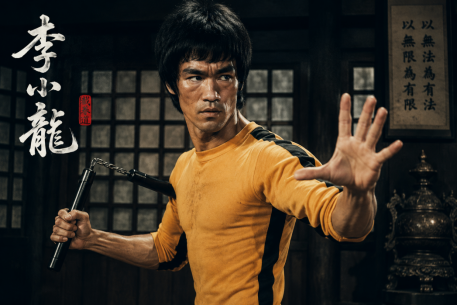
Jeet Kune Do is not a single martial arts school, but an open martial arts philosophy system. Bruce Lee blended boxing, fencing, taekwondo, and other fighting methods, stressing “using no way as way, using no limitation as limitation”, and arguing for breaking free from formal constraints to return to the essence of real combat. He advanced the idea of being like water, holding that a person should adapt to circumstances and change flexibly, as water does. This idea not only shaped the martial arts world, but also became a classic metaphor in cross-cultural exchange.
In the 1970s, Bruce Lee rose to international fame in the film industry with movies such as The Big Boss, Fist of Fury, The Way of the Dragon, and Enter the Dragon. Through his films, he presented to the world the power, speed, and spiritual essence of Chinese martial arts, establishing “kung fu” as one of the most recognized cultural symbols through which global audiences come to understand Chinese culture. His action style was real, simple, and explosive, breaking the stylized combat conventions of traditional films and advancing the modernization of action films.
Culturally, Bruce Lee’s significance lies not merely in his role as a demonstrator of martial arts skills, but more profoundly in his identity as a reconstructor of martial arts philosophy. He emphasized the unity of body and consciousness, opposed rigid sectarian boundaries, and advocated openness, integration, and self-expression. This philosophy is highly congruent with modern concepts of cross-cultural communication, establishing him as an important bridge connecting Eastern martial arts philosophy with Western modern body culture.
Bruce Lee passed away in 1973, but his influence did not cease. On the contrary, his ideas continued to spread globally and profoundly affected the action film industry as well as modern physical training methodologies. What he represents is not merely the legendary life of a martial artist, but rather a cultural spirit that transcends boundaries and embraces constant self-renewal.
Within the historical evolution of Chinese martial arts culture, Bruce Lee’s significance lies in his role in transforming martial arts from skills system to philosophy system, and from a regional culture into a world language. His story remains, to this day, an important cultural footnote to the modernization and worldwide dissemination of Chinese martial arts.