
Wuhan College of Communication Holds China-Foreign Martial Arts Exchange Activity
On May 29, 2026, a China-Foreign Martial Arts Exchange Activity hosted by Wuhan College of Communication was held in Classroom 1302 of the university. Themed “Make Friends through Martial Arts, Educate through Culture, Promote International Exchange,” the event invited foreign friends from France, Canada, Hungary, Indonesia, Nepal, and other countries to participate alongside teacher representatives passionate about martial arts and student representatives majoring in dance from Wuhan College of Communication. Chinese and foreign youth experienced the charm of traditional Chinese culture through martial arts demonstration, Changquan teaching, and cultural exchanges, enhancing mutual understanding and friendship.
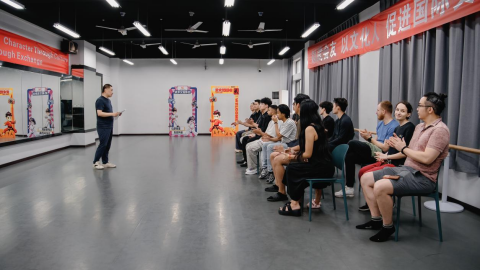
Figure 1. Dean Zhang Hao of the International College of Wuhan College of Communication hosts the activity
The activity was hosted by Zhang Hao, Dean of the International College of Wuhan College of Communication. At the beginning of the event, Dean Zhang welcomed the foreign friends in attendance and briefly introduced the main schedule of the exchange activity. Subsequently, Zhou Tsz Shan Sam (Jeffrey), a student at Cheltenham College in the United Kingdom, a martial arts enthusiast, and President of the Martial Arts Exchange Committee of China-Cyprus Friendship Promotion Association, exchanged ideas with teacher and student representatives as well as foreign friends on the topic of Chinese martial arts. Zhou Tsz Shan Sam (Jeffrey) has practiced martial arts since the age of 4 and has won championships in Beijing's same-age group martial arts competitions for consecutive years. At this event, he served as a martial arts exchange representative, leading Chinese and foreign youth to experience Chinese martial arts together.
In the exchange experience session, Zhou Tsz Shan Sam (Jeffrey) selected Changquan (Long Fist) as the teaching content. He explained that Changquan is a relatively basic and representative form in martial arts, with expansive and graceful movements and a distinct rhythm, making it suitable for beginners to experience the basic form of Chinese martial arts. On site, he started with standing posture, hand positions, footwork, and movement transitions, demonstrating while explaining, and promptly correcting movements based on everyone’s learning progress.
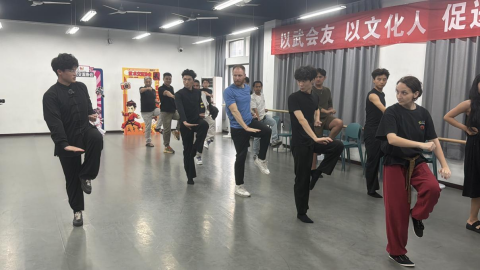
Figure 2. Zhou Tsz Shan Sam (Jeffrey) leads Chinese and foreign youth in learning basic Changquan movements
Under the guidance of Zhou Tsz Shan Sam (Jeffrey), foreign friends and teacher and student representatives of Wuhan College of Communication gradually learned Changquan movements, from opening form and punching to footwork transitions. Everyone practiced while watching, exchanging key points of the movements from time to time, and the atmosphere was relaxed and lively. For many foreign friends who were experiencing Chinese martial arts up close for the first time, Changquan provided not only a session for learning movements but also a more intuitive experience of Chinese martial arts through personal participation. Through each movement, martial arts became a common link for youth from different cultural backgrounds to transcend language barriers and deepen mutual understanding.
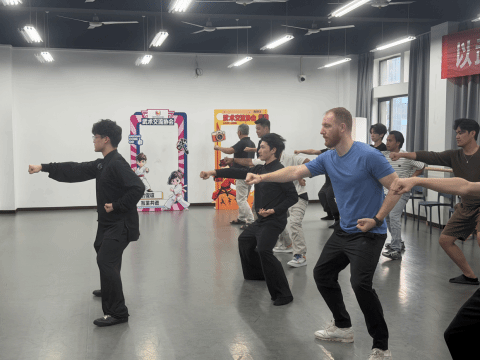
Figure 3. Chinese and foreign youth practice Changquan together
At the event, Szabo Dorotyya, a Hungarian student currently studying at Wuhan University, gave a Sword (Jian) demonstration. Her fluid movements and graceful posture won applause from the audience. It is understood that she first became interested in Chinese martial arts because she loved Chinese wuxia TV dramas and wanted to imitate the movements in the shows, as well as to personally experience the atmosphere of wuxia culture. At this exchange activity, she not only gave a Sword demonstration but also participated in the on-site learning. When asked about her experience, she said that practicing with everyone was very interesting, and she used the term “opening up” to describe her feelings, noting that the activity had broadened her understanding of Chinese martial arts.
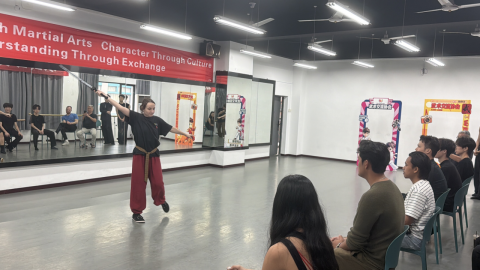
Figure 4. Szabo Dorotyya gives a Sword (Jian) demonstration
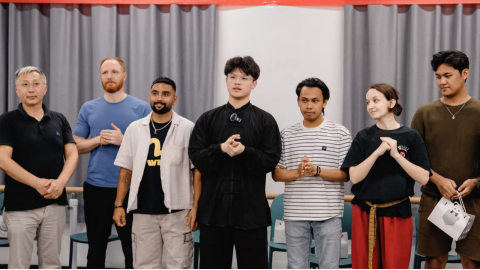
Figure 5. Zhou Tsz Shan Sam (Jeffrey) exchanges activity impressions with Foreign Friends
Tang Lin, senior teacher and renowned scholar at Wuhan College of Communication, remarked during the exchange that martial arts is an important component of traditional Chinese culture and an important manifestation of national spirit. Practicing martial arts is not only physical training but also spiritual discipline. Those who practice martial arts often gain a deeper appreciation of patriotic sentiment, sense of responsibility, and tenacious character. The reason Chinese martial arts can transcend language and national borders lies in both its external beauty of movement and inner spiritual power.
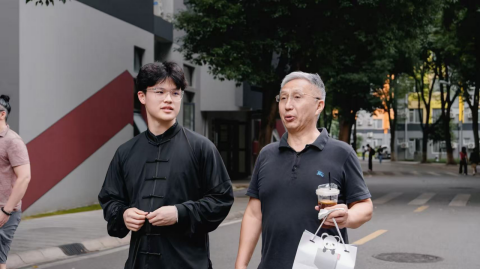
Figure 6. Zhou Tsz Shan Sam (Jeffrey) exchanges with Tang Lin, senior teacher and renowned scholar at Wuhan College of Communication
At the end of the activity, gift presentation and group photos took place on site. Subsequently, accompanied by teacher and student representatives of Wuhan College of Communication, foreign friends visited some broadcasting studios in Building 6 and the campus, further learning about the university’s practical teaching space and campus cultural atmosphere. During the visit, teacher and student representatives and foreign friends exchanged views on campus development, professional practice, and cultural exchanges.
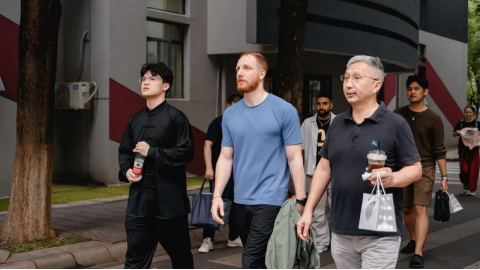
Figure 7. Foreign friends visit the campus of Wuhan College of Communication
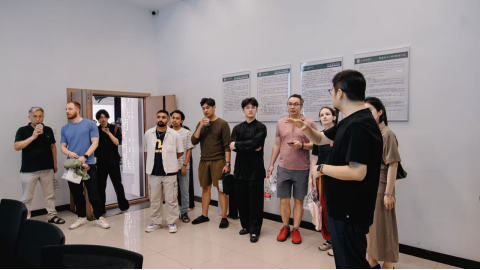
Figure 8. Foreign friends visit the practical teaching space of Wuhan College of Communication
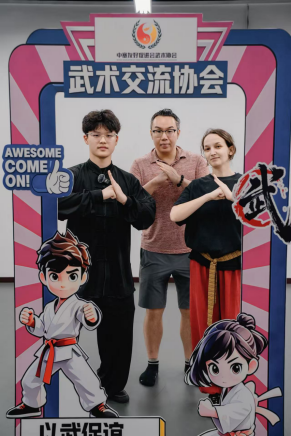
Figure 9. Chinese and foreign guests take a group photo in front of the Martial Arts Exchange Committee display board
This China-Foreign Martial Arts Exchange Activity was not only a martial arts experience activity but also a cultural dialogue between Chinese and foreign youth. Using the campus as a platform, Wuhan College of Communication integrated traditional Chinese culture into the international exchange setting, allowing foreign friends to understand Chinese culture through observation, participation, and hands-on experience while also enabling teachers and students to strengthen cultural confidence and expand international vision through exchanges. In the future, Wuhan College of Communication will continue to leverage its role as a platform for cultural education and international exchanges, promoting more diverse forms of China-foreign cultural exchange activities, so that excellent traditional Chinese culture can be disseminated through youth exchanges and radiate new vitality through mutual learning among civilizations.
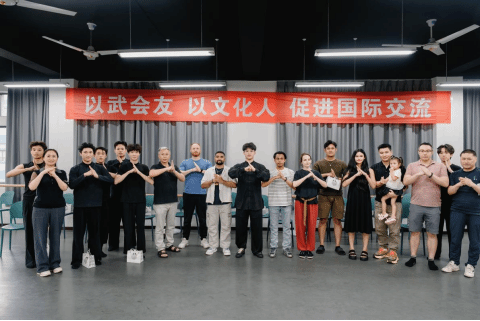
Figure 10. Group photo of activity participants