

Six Tai Chi Movements for Beginners
Tai Chi is a treasure of Chinese martial arts passed down with a thousand-year history. It does not rely on explosive force but uses gentle movements to stretch muscles and regulate breath. Without difficult moves or space restrictions, it can be practiced in parks or at home.
This article shows a complete and simplified Tai Chi routine with six basic movements. Each movement is clearly broken down step by step, so beginners can quickly get started and experience the sense of relaxation of Chinese Kung Fu with every breath.
I. Opening Form: Stand Upright and Open the Stance, Stretch the Whole Body
Stand with feet shoulder-width apart, and bend knees slightly while sinking. Incline the head gently to one side, open both arms to the sides of the body, and slowly push the palms outward.
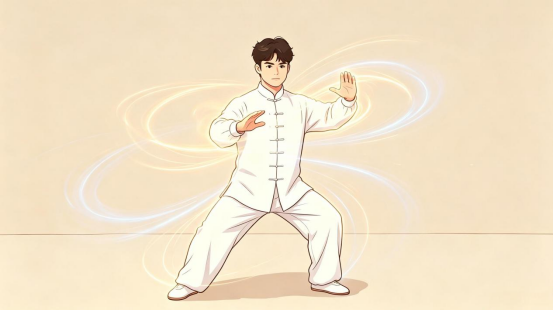
Let the shoulders sink naturally, keeping the body upright and centered. Slow down the entire movement, regulate the breathing evenly, and lay the foundation for the whole routine.
II. Step Down: Sink the Hips and Place the Foot, Stabilize the Lower Base
Slowly sink the center of gravity. Place the foot down heel-first, and then gradually press the entire sole onto the ground.
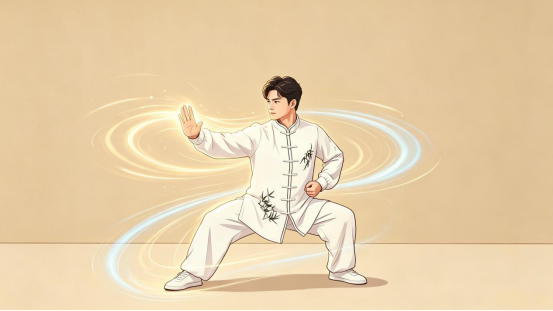
Keep both legs relaxed, sunk, and bent, with the feet firmly in Horse Stance (Ma Bu). In Tai Chi, the lower body is the root. Only when the foot placement is stable, can the subsequent movements flow smoothly, avoiding any swaying of the body.
III. Cloud Hands: Waist Drives the Arms, Flowing Like Clouds
Regard the waist as the axis to guide both arms. Trace continuous circular arcs in front of the chest and abdomen, with the left and right hands alternating in rotation.
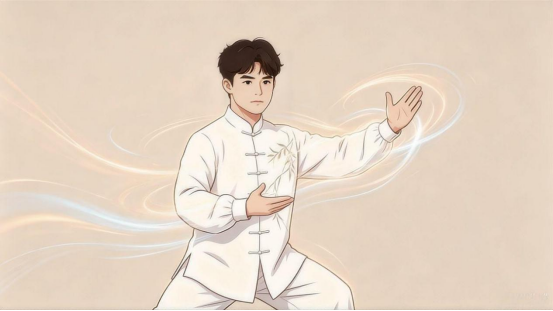
Move the feet slowly and laterally, keeping the lower body in a half-squat position. The entire movement resembles clouds drifting through the mountains, fully engaging the waist and hips while developing body coordination.
IV. Turning: Twist the Waist and Rotate the Body, Keep Continuous and Unbroken.
Use the waist and hips to drive the torso in a smooth turn. The feet follow the body with slight adjustments in angle, while the upper body remains upright and centered throughout.
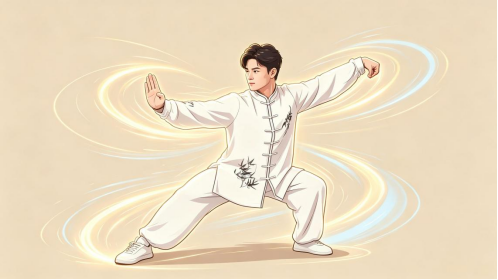
The entire turning movement should be continuous. Use only the waist and hips to drive the rotation. Do not stiffly twist the shoulders. Maintain the core essence of Tai Chi: relaxed, lively, round, and flowing.
V. Open and Close: One Open, One Close, Synchronized with the Breath
Slowly open both arms outward, expanding the chest, and inhale; then draw both hands inward, as if embracing, to the space between chest and abdomen, and slowly exhale.
Each opening and closing corresponds to one inhalation and one exhalation. The rhythm of movement follows the breathing frequency completely, using the limbs to guide the flow of qi and blood, thereby nourishing the internal organs.
VI. Closing Form: Gather the Breath and Return to the Origin, Calm the Mind and Close the Practice
Slowly lower both hands to the Dantian in the lower abdomen, gradually stand up straight, and completely relax all muscles.
Let the breath settle, drawing all the body’s power back inward. The entire Tai Chi practice is now complete. The Closing Form should never be rushed. A calm and peaceful mind is the essential principle for concluding the practice.