

Learn the Bow Stance Punch in Five Steps
The Bow Stance Punch is the most classic basic technique of Chinese martial arts and a core foundation skill shared by Changquan / Long Fist, Tai Chi / Taijiquan, and Hongquan. The full sequence balances hardness and softness: the feet are planted firmly in Horse Stance (Ma Bu) while the punch extends with strength, which builds lower-body power and refines the way force is delivered through the punch.
This article breaks down the complete practice sequence of the Bow Stance Punch, which consists of five connected movements. The movement standards are plain and easy to follow. You can practice at home or in an open square, and martial arts enthusiasts overseas can pick it up with ease.
I. Step-by-Step Teaching of the Full Sequence
1. Withdraw Fist: Sink the Body and Store Power, Ready to Release
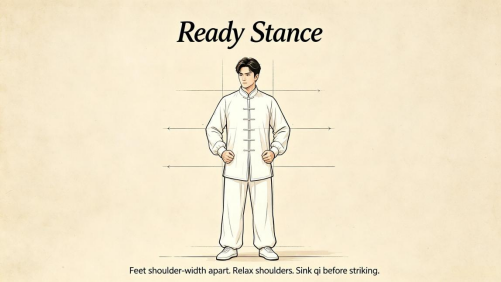
Hold a half Bow Stance (Gong Bu) position and draw both fists back to the waist, with the palm side of each fist facing up.
Bend both knees and sink down, keeping the center of gravity steady between the two legs. Keep the waist relaxed and hold the power within. Let both shoulders sink down instead of hunching up, and gather all the strength in the waist, hips, and arms, storing up force for the punch.
2. Block: Raise the Arm to Guard, Protect the Centerline
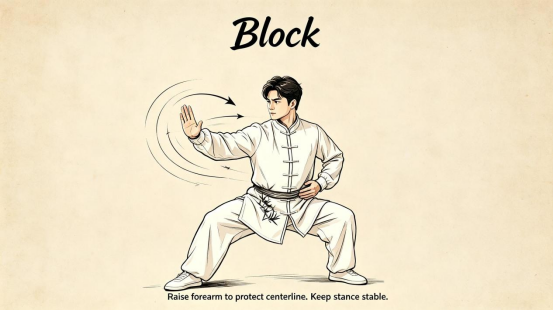
Raise one arm forward, blocking horizontally with the forearm, and hold the hand upright to shield the centerline in front of the body.
Keep the center of gravity stable and maintain the Bow Stance (Gong Bu) in the lower body. The block defends with the outer side of the forearm, and the arm stays relaxed yet firm: it can stop an incoming punch while flowing straight into the next attacking movement.
3. Straight Punch: Twist the Waist and Punch, Force to the Knuckles
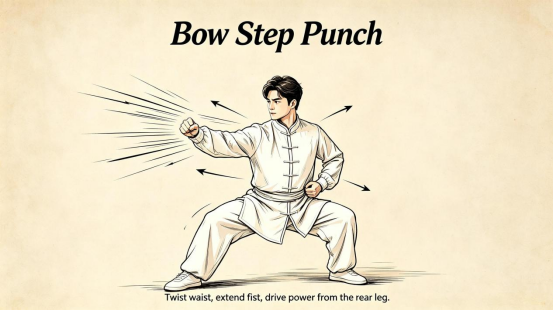
Rotate the waist and hips sharply and drive a straight punch forward on a level path, with the fist eye facing up and the arm fully extended.
As the punch goes out, the leg push, waist turn, and shoulder delivery fire at the same time: force travels from the soles of the feet all the way to the striking surface of the fist, and the movement is crisp and clean. The front leg bows while the rear leg drives, the lower body stays firmly rooted, and the torso does not waver.
4. Turning Hook Punch: Twist the Waist and Sweep, Strike on a Horizontal Path
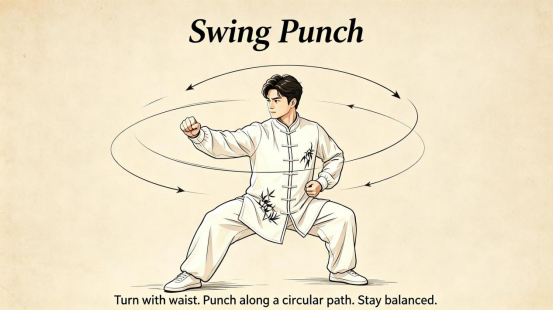
Turn the body with the waist and hips, shift the center of gravity smoothly, and swing one arm out horizontally to deliver the hook punch.
During the turn, the feet pivot slowly on the ground and the body stays upright without leaning. The hook punch travels on an arc, with the waist driving the arm to deliver force. The movement opens wide and covers both attack and defense.
5. Closing Form in Horse Stance: Settle Back into the Stance, Calm the Breath
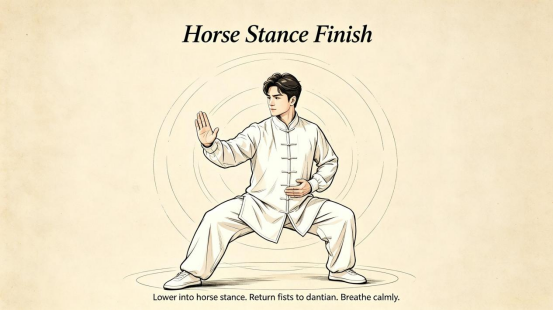
Draw both fists back, sink the legs slowly, settle firmly into Horse Stance (Ma Bu), and return the body to a centered, upright position.
Let the muscles of the whole body relax bit by bit, even out the breath, and draw the hard, forceful energy back into the Dantian (the energy center below the navel). The full Bow Stance Punch practice ends with a complete Closing Form: the Opening Form stores power, and the Closing Form keeps strength in reserve.
II. Practice Tips
In Bow Stance (Gong Bu), the front leg bows and the rear leg pushes, with the toes pointing forward and the knee never passing beyond the toes. This protects the knee joint.
Do not deliver the punch with brute arm strength alone. Rely on the whole-body power generated by the leg push and the waist turn, so the punch carries force clean through.
Keep the pace of the full sequence even, with attack and defense flowing together smoothly. Beginners can slow down, get the movement framework accurate first, and then build up the rhythm of force delivery step by step.
This basic punching technique requires no special space. Repeated practice in spare moments builds a solid foundation in martial arts.