

An In-Depth Guide to Jeet Kune Do
Among the many martial arts systems, Jeet Kune Do is the most distinctive and holds the greatest modern value. There is no cumbersome or fixed routines and it rejects the constraints of school divisions. Drawing on years of training experience, Bruce Lee fused the essence of Chinese and foreign kickboxing to create an original practical modern martial way.
Unlike traditional martial arts, which emphasize routine performance and the transmission of fixed techniques, the core of Jeet Kune Do comes down to two words: simplicity and efficiency. Whether for strengthening the body, self-defense, or understanding martial way philosophy, Jeet Kune Do is one of the most suitable martial arts for ordinary people to learn.
I. The Origin of Jeet Kune Do: A New Martial Way That Breaks All Constraints
Jeet Kune Do was founded by Bruce Lee in the 1960s and was the first Chinese-style modern practical martial art to reach the international stage.
In his early years, Bruce Lee trained deeply in Wing Chun while also studying boxing, fencing, Muay Thai, Western kickboxing, and other fighting disciplines. He found that the rigid routines and formulaic rules of traditional martial arts greatly limited adaptability in real combat.
Real fighting is ever‑changing. A fixed move never fits all. Based on this core insight, Bruce Lee broke through all school barriers, took the strengths of each style, discarded redundant forms, eliminated flashy and useless movements, and kept only the core techniques suited for real combat, ultimately creating the unique Jeet Kune Do. Its ultimate martial way philosophy runs throughout: Using No Way as Way, Using No Limitation as Limitation.
II. The Core Meaning of Jeet Kune Do: Understanding “Intercept, Fist and Way”
Many people assume that Jeet Kune Do is simply a set of punching techniques. In reality, it is a complete system of techniques, tactics, thinking, and mindsets. Three Chinese characters indicate its essence:
Intercept — Intercept First, Seize the Initiative
This is the core tactic of Jeet Kune Do. Instead of waiting passively for the opponent to finish an attack before countering, it anticipates the opponent’s movements and completes the interception, disruption, and neutralization at the very moment the opponent generates force or launches a strike. The result is striking second but arriving first, using speed to overcome slowness.
Fist — Minimalist Techniques, Strike at the Vital Points
It discards flashy, ever-changing moves and is built on punching techniques, kicking techniques, footwork, and blocking. Every movement serves real combat, pursuing the shortest distance, the fastest speed, and the highest precision.
Way — Adaptability as the Foundation, Cultivating the Mind as the Priority
Techniques are the foundation; adaptability is the core. Jeet Kune Do has no absolute standard. The movement that suits the situation and solves the problem is the best movement. It also stresses Martial Virtue before learning martial arts, using the martial way to sharpen one’s character and cultivate a steady mindset.
III. A Plain Explanation of the Core Techniques of Jeet Kune Do
Jeet Kune Do has no set forms. Its core moves are simple, practical, and highly effective—that’s what daily training emphasizes.
1. Lead Straight Punch (Core Primary Technique)
It is the most fundamental and most frequently used technique in Jeet Kune Do. The movement is straight, short, and highly deceptive, with extremely fast punching speed. It is mainly used to probe the opponent, disrupt their rhythm, and land precise strikes. The power does not come from brute arm force but from the instantaneous explosion of the waist and hips, making it light, swift, and clean.
2. Rear Power Punch (Finishing Strike Technique)
Compact in its power storage and strong in penetrating power, it avoids large-arc swings and focuses on precise, heavy strikes. It is mostly used to exploit gaps in the opponent’s defense and deliver suppressive strikes, making it the core finishing technique in real combat.
3. Straight Side Kick (Signature Kick Technique)
Unlike the high leg swings of traditional martial arts, the Jeet Kune Do side kick follows a straight-line trajectory. The leg rises low, retracts quickly, and keeps the center of gravity stable. It can intercept from a distance to control range or directly deliver a heavy strike to the opponent, serving both offense and defense.
4. Centerline Slap Block (Signature Defense)
It discards the hard-blocking, force-against-force approach to defense. Instead, it uses light deflections and slaps to redirect the opponent’s attacks, saving energy and maintaining the center of gravity. The moment the block is completed, a counterattack can be instantly connected.
5. Dynamic Pursuit Footwork
Jeet Kune Do does not hold Zhan Zhuang. It emphasizes moving with the technique and pressing forward step by step. Through small sliding steps to adjust distance, the offense maintains continuous pressure while the defense dodges flexibly, adapting to all combat rhythms.
IV. Correct Training Methods for Beginners
Jeet Kune Do has a low entry barrier and requires no deep martial arts background. Beginners can follow a systematic training sequence:
1. Solidify the Fighting Stance
Stand sideways with the Center of Gravity Sinking, both hands guarding the face, and feet positioned front and back. Keep the body relaxed, not stiff, and maintain a state of readiness for offense and defense at all times. This is the foundation of all movements.
2. Focus on Straight-Line Punching
Repeat shadow boxing with straight punches. Prioritize developing speed, precision, and the timing of force generation. Do not chase raw power. Build a standard muscle memory.
3. Train Range-Control Footwork
Practice forward and backward sliding steps and small, precise adjustment footwork. Develop a sense of distance so that you can advance and retreat, flexibly adapting to the distance for offense and defense.
4. Practice Interception Reactions
Simulate scenarios of the opponent punching. Build the instinctive flow of “block and counter.” Fully absorb the core logic of Jeet Kune Do: intercept first.
5. Combine Simple Combinations
For beginners, there’s no need for complicated techniques. Getting proficient with basic combos—like double jabs into a side kick, or a block into a rear‑hand punch—is more than enough for everyday self‑defense.
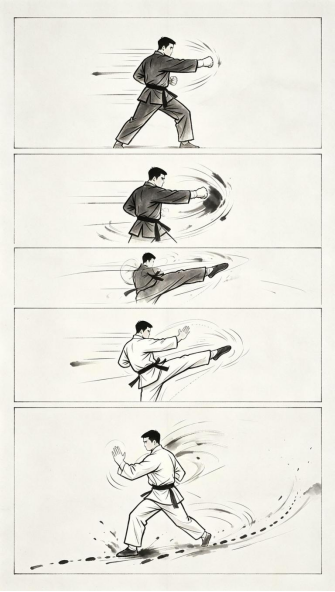
Jeet Kune Do transcends mere martial technique; it embodies a refined, transparent philosophy that extends to all aspects of life.
It teaches you to cut away the unnecessary and get straight to the heart of things, to let go of fixed mindsets and embrace adaptability. Win with speed, triumph with simplicity. In the interplay of action and stillness, you develop unshakable composure; in the exchange of attack and defense, you refine your inner self. That is the invaluable wisdom of Jeet Kune Do that Bruce Lee left for the world.