

A Popular Guide to Traditional Martial Arts Weapons
When people speak of Chinese martial arts, they usually think first of the endlessly varied hand and foot techniques and the many schools of fist forms, yet the many traditional weapons are among the most brilliant gems of martial arts culture. Over the centuries, martial arts weapons have gradually evolved from practical combat arms on ancient battlefields into carriers for physical cultivation, health preservation, and the transmission of forms.
Many practitioners come to realize after years of training that weapons are an extension of their bare-hand Kung Fu. Mastering a weapon gives one a better command of power generation, distance, and rhythm, and it makes the martial foundation more solid. This article takes you through the mainstream weapons of Traditional Martial Arts and the core characteristics of long, short, soft, and hard weapons.
I. Long Weapons: An Inch Longer, an Inch Stronger
Long weapons are the mainstream of traditional martial arts. Their advantage lies in long attack range and wide coverage, balancing offense and defense, and they are also the most common category in daily martial arts practice.
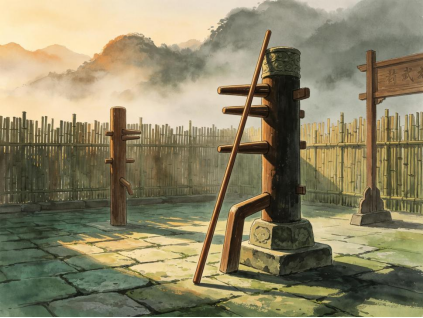
Staff: The mother of all weapons. The staff has no blade and no edge. Plain and unadorned, it has the lowest barrier to entry and the widest range of uses. Its defining feature is captured in the saying “a staff sweeps a wide arc,” meaning broad, forceful, and fast movements. Whether it is a basic eyebrow-height staff or an ornamental staff routine, it emphasizes fierce and steady power, making it the first choice for beginners entering weapon practice.
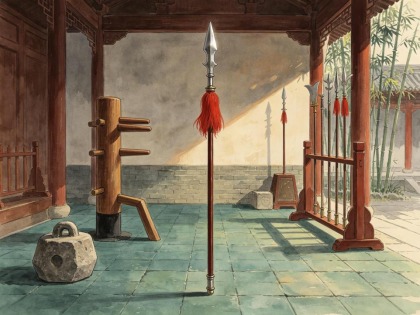
Spear: The king of all weapons. The spear was a core weapon on ancient battlefields, and it has long been said that “a spear thrusts in a straight line.” With a slender form and precise sharpness, its techniques mainly consist of thrusting, stabbing, lifting, and blocking. It demands accurate power generation and a blend of real and feigned actions, and it is excellent training for coordination and concentration.
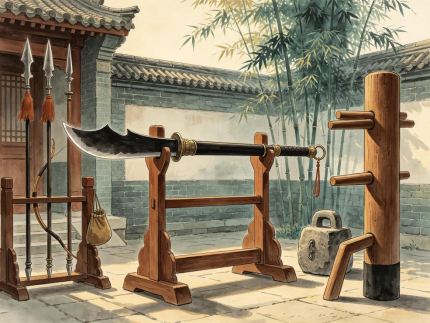
Broadsword / Spring and Autumn Broadsword: A representative of heavy long weapons, with a majestic presence. Its techniques center on splitting, chopping, cutting, and upward slicing. The movements are expansive and grand, projecting fierce, heavy power and the righteous spirit of the martial artist. It is also a classic weapon in traditional routines and martial arts performance.
II. Short Weapons: Compact and Fierce, Close-Range Subduing
Short weapons are light, flexible, and easy to carry. Short weapons are light, flexible, and easy to carry. They are built for close-quarters offense and defense and for defeating an opponent quickly. Suited to short-range combat, they are far more agile than long weapons.
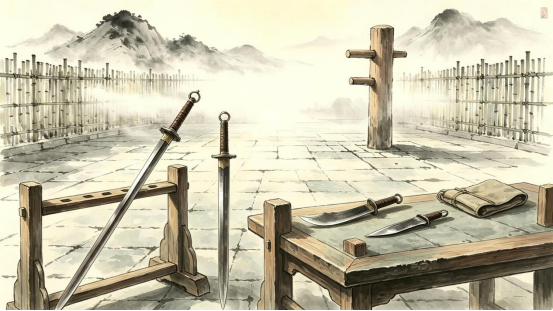
Sword: The gentleman of all weapons. The sword is the most refined and elegant of the traditional weapons. Unlike the fierce broadsword, swordplay values lightness, grace, and the Unity of Hardness and Softness. Its core techniques are pointing, thrusting, chopping, lifting, and sweeping. Forms such as the Tai Chi Sword and the Qingping Sword are widely practiced, and the sword both strengthens the body and is highly pleasing to watch.
Dagger / Short Broadsword: An excellent tool for close-range self-defense. Small in size and highly concealable, it relies on simple, sharp techniques focused on fast attacks at close quarters and on breaking out of an opponent’s defense. It is a highly practical short weapon in traditional self-defense martial arts.
III. Soft Weapons: Ever-Changing, Softness Overcomes Hardness
Soft weapons are a distinctive category of Chinese martial arts. With no fixed shape, they can be released and retracted at will and transform without end. They are the most difficult to master, the most spectacular to watch, and the category that best demonstrates the skillful use of force in martial arts.
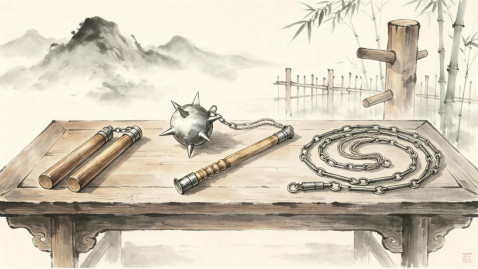
Nunchucks / Double Section Staff: A classic weapon known to every household, widely popularized through Jeet Kune Do. Combining long and short, hard and soft, they can attack at a distance and defend up close. The force is short, sharp, and explosive, and the techniques are highly versatile, serving both real combat and eye-catching demonstration.
Nine-Section Whip: A classic representative of soft weapons, with remarkable mobility. It can wrap, sweep, lash, and strike, capable of long-distance attacks and also close-range wrapping defense. It places extremely high demands on the coordination of body movement and weapon, showing the charm of martial arts in flowing, graceful motion.
Meteor Hammer, Rope Dart: Traditional exotic soft weapons that rely on ropes for power generation and precise long-range strikes. Their techniques are ingenious, making them highly distinctive niche classic weapons in traditional martial arts.
IV. Basic Martial Arts Knowledge
No traditional weapon is meant to encourage aggression or rivalry. Modern Martial Arts weapon practice has shed the killing edge of ancient warfare and kept instead the wisdom of power generation, the rhythm of body movement, and the spirit of Wu De (Martial Virtue) built up over a thousand years of martial arts.
Long weapons train momentum, short weapons train agility, and soft weapons train control. Every weapon is a refinement of body and mind. Starting from the basic saber, spear, sword, and staff, and progressing step by step, one can understand the unique charm of traditional weapons and discover a different martial arts world.