

The Five Basic Stances
Many martial artists like to say, “Before practicing punches, practice Zhan Zhuang — the root must stand as firm as a mountain.” Punches may vary endlessly, but their source is always the lower body. Bow Stance (Gong Bu), Horse Stance (Ma Bu), Empty Stance (Xu Bu), Drop Stance (Pu Bu), and Cross-Leg Stance (Xie Bu) are the five core basic stances of traditional martial arts; they are both beginner‑level exercises and the foundation of whole-body power. Only when the stance structure is steady and the feet are rooted can a punch come out solid, whole, and penetrating.
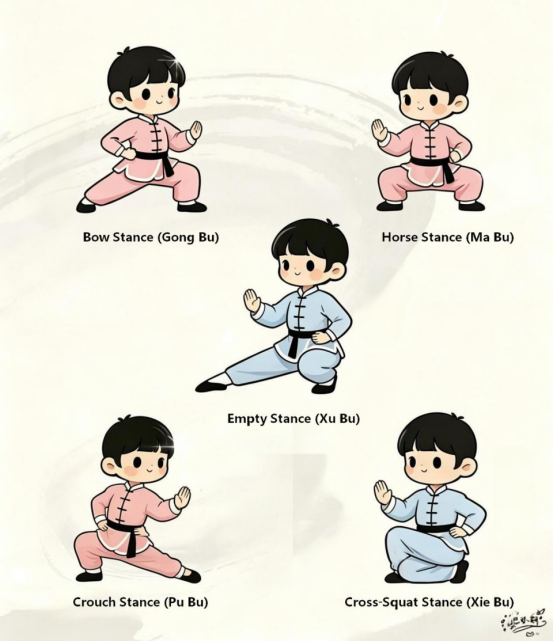
I. Horse Stance (Ma Bu): The Mother of All Stances, Sink the Hips and Take Root
Stand with the feet parallel and slightly wider than the shoulders. Bend the knees and sink down until the thighs are nearly level, with the knees pointing in the same direction as the toes — never caving inward or flaring outward. Keep the waist relaxed and the torso upright, lift the crown of the head, and hold the hands in front of the chest.
This stance develops sinking power: relax the hips, bend the knees, and let the weight settle evenly over the Yongquan points on the soles of both feet. The front of the thighs, the buttocks, and the waist and abdomen brace together as one unit, with the feet pressed firmly into the ground. Horse Stance trains static strength in the lower body, building the legs into a base as solid as bedrock — no matter how hard an opponent charge in, the body does not budge.
It is the core exercise for base endurance, and the foundational stance in Tai Chi, Long Fist, and Southern Fist.
II. Bow Stance (Gong Bu): Draw the Bow to Store Power; Drive Out Through the Front Foot
Step the front foot forward in a long stride; the front leg bends like a bow while the back leg pushes straight. The front toes point forward with the knee not extending past the toes; the back toes turn slightly inward with the entire sole flat on the ground. Keep the torso upright, with the weight split 70/30 — seventy percent on the front leg and thirty percent on the back leg.
This is a power-storing stance. The back leg drives off the ground and propels the hip forward while the front leg bows and receives the load, creating a counter-pulling tension between the leg that drives and the leg that supports. The front foot can burst forward and the back foot can brace backward; in the form, the power behind every Straight Punch and Splitting Fist (Pi Quan) comes from the drive and rotation of the Bow Stance.
It is the most frequently used stance for switching between attack and defense, built for forward advances and the explosive release of hard power.
III. Empty Stance (Xu Bu): Shift Between Full and Empty; Turn and Dodge with Ease
One leg sinks into a full squat with the thigh pressed tightly against the calf, and the weight settles entirely onto the back leg. The front foot rests on its toes with the heel off the ground and the knee slightly bent — the front foot only grazes the floor, and its height can be adjusted as needed.
Full and empty must stay clearly separated: the weight locks firmly onto the solid leg while the front leg stays light and loose. This lets the center of gravity shift forward or back at any moment — step in to attack, or step out to evade. Empty Stance trains agility in the feet and keeps the base from going stiff and inflexible.
It is the core footwork for parries, retreats, and changes of direction, frequently used in Tai Chi and Xingyi Quan.
IV. Drop Stance (Pu Bu): Sink the Body Low, Defend from a Low Frame
One leg drops into a full squat with the buttocks sinking back against the calf, while the other leg stretches out flat along the ground, toes turned inward and the sole pressed firmly onto the floor. Keep the upper body upright — no bending at the waist or hunching the back.
This is sinking power in a low frame: the hip joint releases downward, stretching the ligaments along the inner thighs. With the weight dropped and the base very low, the stance is built to block low kicks, and it also allows you to sweep an opponent’s legs from a crouched position.
It is the foundational stance for ground techniques and for attack and defense at low-kick level.
V. Cross-Leg Stance (Xie Bu): Twist the Waist and Lock the Legs; Wrap the Body Tight
Cross the legs and squat down: the front foot lands flat on its full sole, while the back heel lifts so that only the ball of the foot touches the ground. The two legs lock and wrap around each other, the buttocks sink down onto the calf of the back leg, the body twists, and the waist stays centered.
The stance produces Spiral Twisting Power: the two legs brace against each other in a cross, and force issues from the twisting of the waist and hips. With the body compact and tightly closed, the base cannot be upended in close-range grappling.
It is the dedicated stance for close-range grappling and for attack and defense in short striking.
Each of the five stances has its own job: Horse Stance builds the foundation of the lower body, Bow Stance trains forward power release, Empty Stance trains advancing, retreating, and agile turns, Drop Stance trains low-frame defense, and Cross-Leg Stance trains close-in twisting and wrapping. In stance training, going lower is not automatically better — what matters is relaxing the waist, sinking the hips, keeping the knees in line with the toes, and maintaining opposing tension through the muscles and bones of the whole body. Only when these five basic stances are solid does the form take root: power rises from the feet, passes through the waist, and arrives at the fists and feet.